
News
Metallica M72 Glasgow 2026 Pop-Up Shop Poster: Gothic Horror Takes Over Scotland
Jun
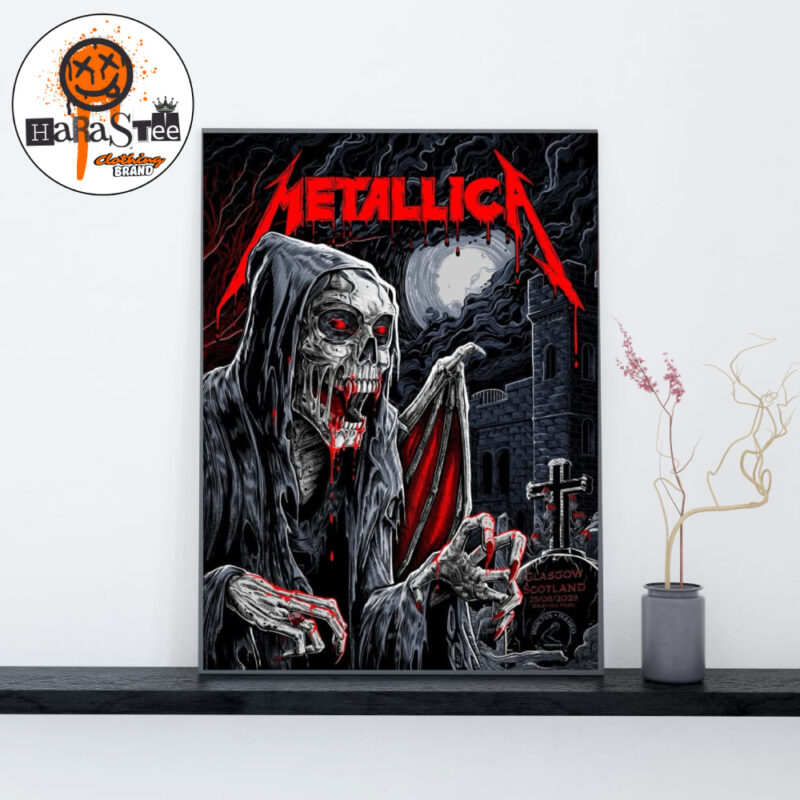
The official Metallica M72 Glasgow 2026 Pop-Up Shop Poster is one of the darkest and most horror-driven pieces released during the European leg of the M72 World Tour. Created by artist Landon Armstrong for Metallica’s stop at Hampden Park in Glasgow, Scotland on June 25, 2026, the artwork abandons mythology and fantasy symbolism in favor of full gothic nightmare imagery.
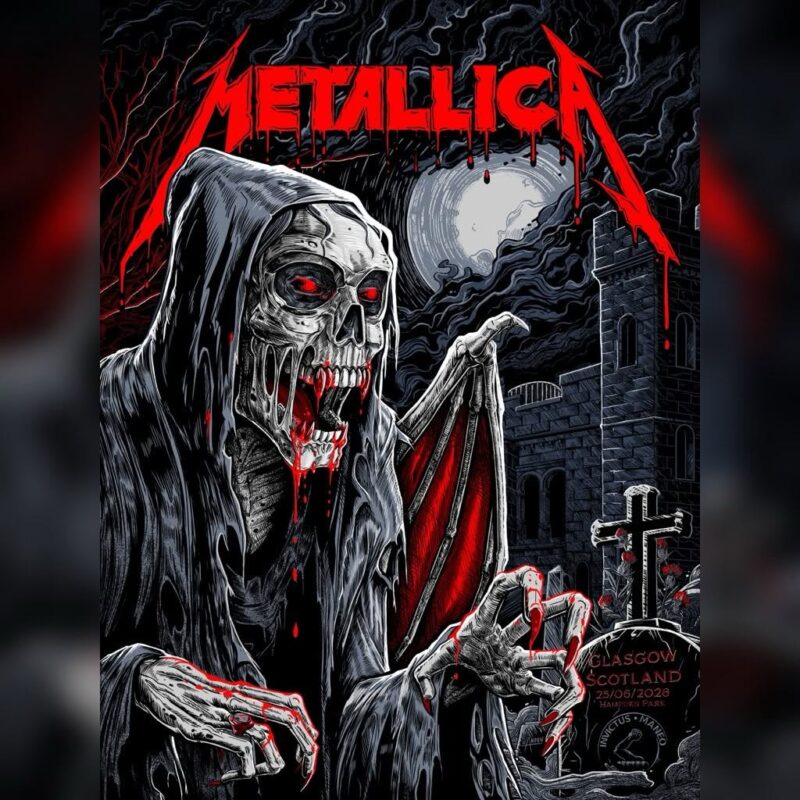
Where other 2026 M72 posters leaned into folklore, monsters, or local cultural references, Glasgow delivers something colder and more direct—a skeletal apparition emerging from darkness beneath a full moon, framed by graveyard imagery and ruined stone architecture.
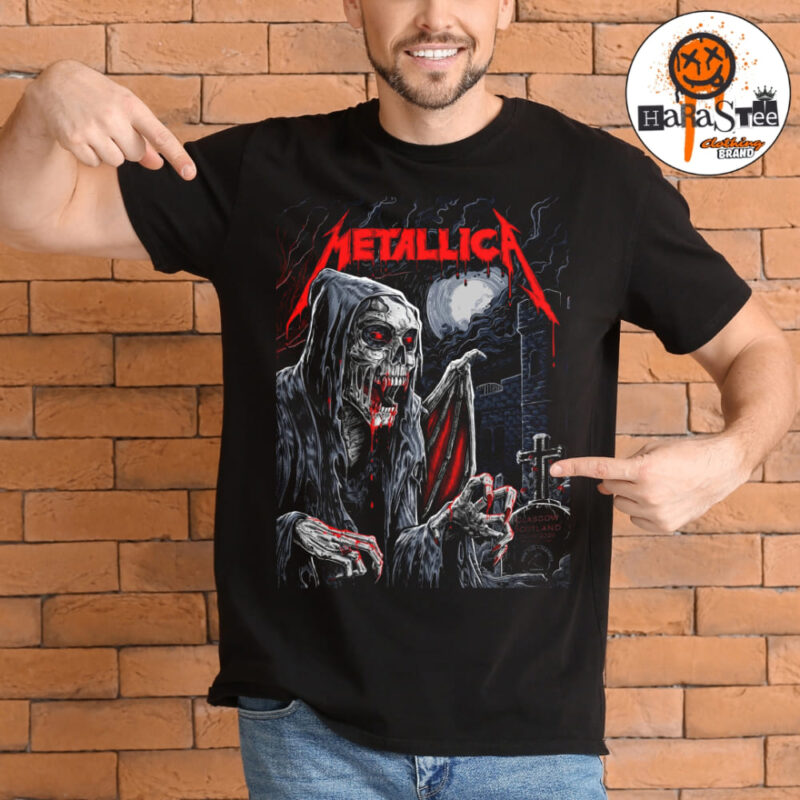
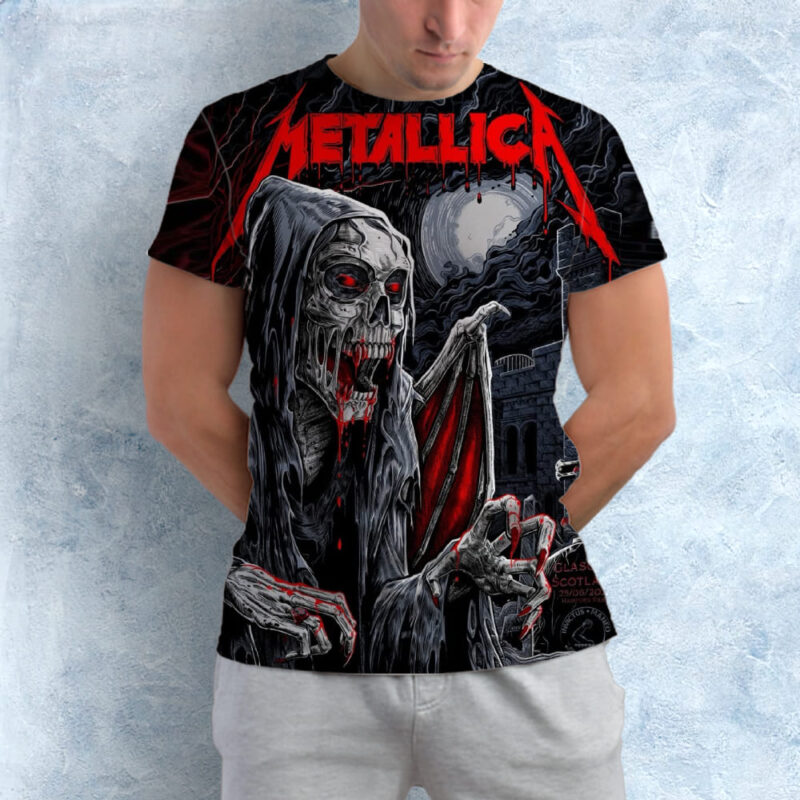
Official event page:
Metallica Glasgow Official Event Page
A Poster That Feels Pulled from Classic Heavy Metal Horror
The moment you see the artwork, one thing becomes obvious.
This is not subtle.
The central figure dominates the entire composition:
- skeletal face
- glowing red eyes
- torn black hood
- blood-red interior cloak
- elongated claws
- dripping crimson details
The character feels somewhere between:
- Grim Reaper mythology
- classic vampire illustration
- 1980s horror comics
- underground metal cover art
Unlike posters that create mystery through symbolism, Glasgow uses immediate visual impact.
The creature is here.
It sees you.
And it owns the scene.
Black, White, and Red Create Maximum Contrast
One of the strongest design choices is restraint.
The artwork is almost monochrome.
Most of the image is built from:
- deep black shadows
- cold gray stone textures
- white moonlight
Only one color breaks through.
Red.
Red appears in:
- the Metallica logo
- the eyes
- the mouth
- dripping details
- hidden accents throughout the composition
This makes every red element feel aggressive.
Nothing appears accidental.
The blood-like treatment of the Metallica logo gives the poster an old-school horror aesthetic that feels closer to vintage metal flyers than modern digital art.
Glasgow Becomes a Stage for Gothic Architecture
Behind the skeletal figure stands a dark stone structure that resembles medieval Scottish architecture.
Combined with cemetery imagery and moonlit skies, the setting immediately evokes:
- ancient stone castles
- ruined towers
- gothic cathedrals
- haunted folklore landscapes
Even though the poster does not recreate a recognizable Glasgow landmark directly, the visual language still feels connected to Scotland.
Stone.
Weather.
History.
Atmosphere.
The city becomes less of a location and more of a mood.
The Grave Marker Creates an Unexpected Local Detail
One of the most interesting details appears in the lower-right area.
A gravestone contains event information and references Glasgow, Scotland — 25/06/2026.
This transforms what could have been ordinary typography into part of the artwork itself.
Instead of announcing a concert.
The design presents the show as an event carved into memory.
The gravestone becomes symbolic.
Not death.
Immortality.
A permanent mark.
That interpretation fits Metallica’s touring history remarkably well.
Landon Armstrong’s Style Fits Metallica Naturally
Artist Landon Armstrong brings a visual approach that feels immediately compatible with Metallica’s identity.
His line work emphasizes:
- exaggerated facial structure
- heavy shadow contrast
- sharp anatomy
- comic-inspired horror detail
- theatrical composition
Rather than polished realism, the image embraces stylization.
That decision makes the poster feel timeless.
It could exist equally well as:
- a concert poster
- a horror book cover
- vintage metal merchandise
- underground illustration art
Why Glasgow Feels Different from Recent M72 Posters
Looking across the 2026 European run, each city developed its own personality.
Recent examples leaned toward:
- mythology (Dublin)
- fantasy creatures (Budapest)
- local symbolism (Berlin)
- cinematic storytelling (Bologna)
Glasgow moves back toward classic heavy metal darkness.
It strips away narrative complexity.
The message becomes simpler:
Something ancient has awakened.
And Metallica provided the soundtrack.
The Moon Is Quietly the Most Important Element
Although the skeletal figure dominates attention, the moon may actually be the visual anchor.
Positioned behind the character, it creates:
- silhouette contrast
- supernatural atmosphere
- dramatic framing
The moon transforms the figure from a monster into an apparition.
Without it, the image would feel graphic.
With it, the artwork becomes cinematic.
It creates the sensation of witnessing something impossible at midnight.
A Poster That Captures Metallica’s Darkest Visual Identity
Metallica’s visual history has always embraced darker themes.
Across decades fans have seen:
- cemeteries
- lightning
- decay
- war imagery
- supernatural symbolism
- apocalyptic landscapes
The Glasgow poster feels connected to that lineage.
It would not look out of place alongside artwork from multiple eras of the band’s history.
That continuity makes the poster feel authentic rather than experimental.
Why Collectors Will Remember the Glasgow Release
Several details make this one stand out.
Strong Horror Identity
The visual direction is immediate and recognizable.
Limited Color Palette
The black-red contrast creates display impact.
Artist Recognition
Landon Armstrong’s illustration style has strong collector appeal.
Event-Specific Storytelling
The gravestone detail ties directly to Glasgow.
Distinct Position Within M72
Among many colorful posters, Glasgow embraces darkness.
Fan Experience at Hampden Park
The Glasgow stop represents one of the major United Kingdom dates of the M72 World Tour.
Fans attending can expect:
- Metallica’s in-the-round stage setup
- full stadium production
- event-exclusive merchandise
- official Pop-Up Shop releases
- city-specific collectibles
As with other M72 events, exclusive posters remain among the most sought-after items throughout concert week.
Final Thoughts on the Metallica M72 Glasgow 2026 Pop-Up Shop Poster
The official Metallica M72 Glasgow 2026 Pop-Up Shop Poster transforms the June 25 show at Hampden Park into a piece of gothic heavy metal artwork.
With:
- a skeletal reaper-like figure
- glowing red eyes
- blood-red typography
- moonlit cemetery imagery
- dark Scottish atmosphere
- and Landon Armstrong’s unmistakable horror style
the poster becomes more than tour merchandise.
It feels like a visual soundtrack.
For collectors, it stands among the darkest releases of the 2026 European run.
For fans attending Glasgow, it captures a night where Metallica turned Scotland into a stage for moonlight, distortion, and classic heavy metal horror.
